
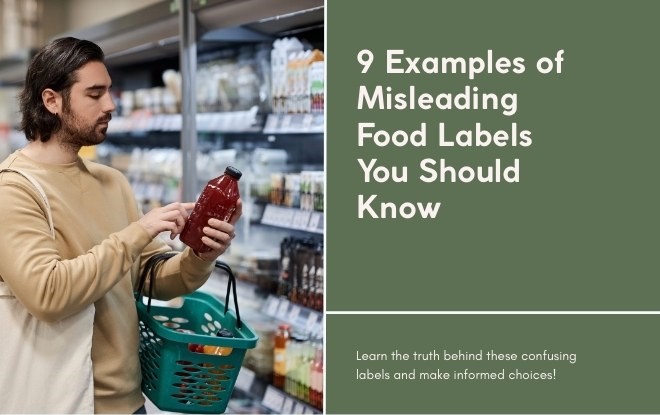
You pick up a box that says “natural.” A yogurt that shouts “low fat.” A granola bar with “made with real fruit.” You feel good about it.
You should not.
I spent two weeks cross-referencing FDA labeling regulations against actual product ingredients in a major grocery chain. The gap between what labels claim and what the food contains is wide enough to drive a truck through. Here are nine specific examples of how food companies legally mislead you — and exactly what to look for instead.
1. “Made with Whole Grains” — The Loophole That Lets Refined Flour In
This sounds healthy. Whole grains mean fiber, vitamins, slower digestion. But the FDA allows this claim if the product contains any whole grain flour — even if it’s the fifth ingredient after white flour, sugar, and oil.
Real example: Nature Valley Crunchy Oats ‘n Honey Granola Bars. The front label says “100% Natural” and “Made with Whole Grains.” The ingredient list? First ingredient is whole grain oats. Second is sugar. Third is canola oil. Fourth is rice flour (refined). Fifth is corn syrup. That’s not a whole-grain product. That’s a sugar delivery vehicle with some oats.
What to do: Flip the box. Look for the word “whole” before every grain ingredient. If it says “enriched flour” or “wheat flour” (without “whole”), it’s refined. The 100% Whole Wheat stamp from the Whole Grains Council is reliable — it requires at least 16g of whole grains per serving.
How much whole grain is actually in there?
The FDA has no minimum threshold for the “made with whole grains” claim. A product could be 5% whole grains and still legally use the phrase. Compare that to the Whole Grains Council stamp: a “100%” stamp means all grains are whole. A “50%+” stamp means at least half. A “Basic” stamp means at least 8g per serving. Anything without a stamp is a guess.
2. “Natural” — A Meaningless Word with No FDA Definition
This is the most abused word in the grocery store. The FDA has no formal definition for “natural” on food labels. The agency’s policy says it means “nothing artificial or synthetic has been added” — but that’s guidance, not a regulation. It is not enforced.
Real example: 7UP Natural. The label says “100% Natural Flavors.” The ingredients include high fructose corn syrup and citric acid. High fructose corn syrup is heavily processed. Citric acid is often produced from black mold (Aspergillus niger) in industrial fermentation. That’s not natural by any reasonable standard.
What to do: Ignore the word “natural” entirely. Look for the USDA Organic seal or the Non-GMO Project Verified seal if those matter to you. Without a third-party certification, “natural” means nothing.
3. “No Added Sugars” — The Trick That Hides Fruit Juice Concentrates
This claim is regulated by the FDA. A product labeled “no added sugars” cannot add table sugar, honey, or syrups during processing. But it can contain fruit juice concentrates — which are chemically nearly identical to sugar.
Real example: Yoplait Original Strawberry Yogurt. The label says “No Added Sugars” on some varieties. The ingredient list includes “evaporated cane juice” (which is sugar) and “fruit juice concentrate.” The FDA has issued warning letters about this, but enforcement is inconsistent.
What to do: Check the “Added Sugars” line on the Nutrition Facts panel. If it shows zero but the ingredient list includes “fruit juice concentrate,” “evaporated cane juice,” “agave nectar,” or “rice syrup,” those are functionally added sugars. The American Heart Association recommends no more than 25g of added sugar per day for women, 36g for men.
4. “Light” or “Lite” — What Are They Actually Reducing?
The FDA says “light” means the product has 50% less fat or one-third fewer calories than the reference product. But the reference product is chosen by the manufacturer. They can pick a high-fat version to make their “light” version look better.
Real example: Wish-Bone Light Ranch Dressing. Compared to their regular ranch, it has 50% less fat. But the regular ranch has 12g of fat per serving. The light version has 6g. That’s still not low fat (which requires 3g or less). And to compensate for the reduced fat, they added more sugar and sodium.
What to do: Compare the “light” version to the average product in that category, not just the manufacturer’s own reference. A better benchmark: look for dressings with under 3g of fat and under 2g of sugar per serving. Bolthouse Farms Yogurt Dressings are a good alternative — they use yogurt as a base instead of oil.
5. “Multigrain” — A Sounding Healthy That Means Nothing
“Multigrain” means the product contains more than one type of grain. That’s it. It does not mean any of those grains are whole. It does not mean they are unrefined. White flour is a grain. White rice flour is a grain. A product made from three different refined flours is legally “multigrain.”
Real example: Pepperidge Farm Multigrain Bread. Ingredients: enriched wheat flour (refined), whole wheat flour, rye flour, oats, barley flakes. The first ingredient is refined white flour. You are paying for the word “multigrain” and getting mostly white bread.
What to do: The word you want is “whole grain” or “100% whole wheat.” If neither appears, assume the grains are refined. Dave’s Killer Bread 21 Whole Grains and Seeds is a reliable choice — every grain is whole, and the first ingredient is whole wheat flour.
6. “Reduced Fat” — Replacing Fat with Sugar and Salt
When manufacturers remove fat, the product tastes worse. So they add sugar, salt, or artificial thickeners to compensate. The result is often less healthy than the full-fat version.
Real example: Jif Reduced Fat Creamy Peanut Butter. Compared to regular Jif, it has 25% less fat (12g vs 16g per serving). But it also has 3g more sugar (4g vs 7g) and 50mg more sodium (135mg vs 185mg). You’re trading healthy unsaturated fats for empty sugar and salt.
| Product | Fat (per 2 tbsp) | Sugar (per 2 tbsp) | Sodium (per 2 tbsp) |
|---|---|---|---|
| Jif Regular Peanut Butter | 16g | 4g | 135mg |
| Jif Reduced Fat Peanut Butter | 12g | 7g | 185mg |
| Smucker’s Natural Peanut Butter | 16g | 1g | 0mg |
What to do: Eat full-fat foods in moderation. The fat in peanut butter, yogurt, and dairy is mostly unsaturated or naturally occurring. If you need to reduce calories, eat a smaller portion of the full-fat version — you’ll get better nutrition per bite.
7. “Good Source of Fiber” — When the Fiber Is Added, Not Natural
The FDA allows “good source of fiber” if a product has 2.5-4.9g of fiber per serving. But that fiber can be added as a processed isolate — chicory root fiber, inulin, maltodextrin — not the natural fiber found in whole foods.
Real example: Fiber One Chewy Bars. The label boasts “35% Daily Fiber” per serving. The fiber comes from chicory root extract. That’s not the same as the fiber in oats or beans. Some studies show added inulin can cause bloating and gas in sensitive individuals. You’re getting the fiber without the vitamins, minerals, and phytonutrients that come with whole food sources.
What to do: Check the ingredient list. If the fiber comes from “chicory root,” “inulin,” or “polydextrose,” you’re getting processed fiber. Real fiber comes from whole grains, legumes, vegetables, and fruits. A bowl of oatmeal (4g fiber) will serve you better than a fiber bar with 9g of added inulin.
8. “0g Trans Fat” — The 0.5 Gram Loophole
The FDA allows a product to claim 0g trans fat if it contains less than 0.5g per serving. That sounds reasonable until you realize the serving size is often tiny. Eat three servings, and you’ve consumed over 1g of trans fat — with a label that says zero.
Real example: Crisco All-Vegetable Shortening. The label says “0g Trans Fat per serving.” The serving size is 1 tablespoon. The ingredient list includes “partially hydrogenated soybean oil” — the primary source of artificial trans fat. A single tablespoon has 0.3g of trans fat. If you use a quarter cup for baking (4 servings), you’ve consumed 1.2g of trans fat.
What to do: Scan the ingredient list for “partially hydrogenated” or “shortening.” If either appears, the product contains trans fat regardless of what the front label says. The FDA banned partially hydrogenated oils in 2018, but products manufactured before that date can still be sold. Check the ingredient list, not the nutrition panel.
9. “Serving Size” — The Most Deceptive Number on the Package
Manufacturers can set their own serving sizes. They make them as small as possible to make the numbers look good. Calories, sugar, salt — all look lower when the serving is 1/2 cup instead of 1 cup.
Real example: Ben & Jerry’s Chocolate Chip Cookie Dough Ice Cream. The serving size is 2/3 cup (about 150g). That’s 280 calories, 18g sugar, 16g fat. But who eats 2/3 cup? Most people eat at least a full cup (420 calories, 27g sugar). The FDA updated serving size regulations in 2026 for some categories, but ice cream serving sizes remain artificially small.
What to do: Look at the number of servings per container. A “single-serve” bottle of Gatorade has 2.5 servings. A bag of potato chips that looks like one portion has 3 servings. Multiply every number on the label by the number of servings you actually eat.
The simplest rule for all of this
Ignore the front of the package. The front is marketing. The back is data. The ingredient list tells you what’s actually in the food. The Nutrition Facts panel tells you how much. If the ingredient list has more than 5 items or includes anything you can’t pronounce, put it back.
Companies spend millions on label design to make you feel good about buying their product. The only defense is reading what’s printed in small type on the back.
Medical Disclaimer: This content is for informational purposes only and does not constitute medical advice. Always consult a qualified healthcare professional before making health-related decisions.